Showing posts with label open source. Show all posts

Thursday, February 24, 2022

25 or Anniversary.Next^10 and early '22 rumblings

In the spirit of work anniversary posts, here's the successor to http://vzimmer.blogspot.com/2021/02/24-or-anniversarynext9-and-128-bits.html.  This post signals the 25th year of working at Intel and 30 years in the industry. 

Since I am so sporadic in blogging, I'll begin with some touches on recent work in the project Universal Scalable Firmware (USF) https://github.com/universalscalablefirmware. I described some of this work at https://talks.osfc.io/osfc2021/talk/HYZL3U/ and it was earlier picked up at  https://www.phoronix.com/scan.php?page=news_item&px=Intel-USF-Firmware, too. The effort builds upon earlier work in FSP https://link.springer.com/book/10.1007/978-1-4842-0070-4 https://www.youtube.com/watch?v=uzfiTiP9dEM  https://www.phoronix.com/scan.php?page=news_item&px=Intel-Better-FSP-License, including adding more traceability https://uefi.org/sites/default/files/resources/Traceable%20Firmware%20Bill%20of%20Materials%20-%2020211207%20-%20007.pdf. It also builds upon earlier OSFC-described work in https://cfp.osfc.io/media/osfc2020/submissions/SLFJTN/resources/OSFC2020_Rust_EFI_Yao_Zimmer_NDK4Dme.pdf and https://2018.osfc.io/uploads/talk/paper/1/OSFC_Keynote-005.pdf.

As always, the hallway track of the last OSFC was the most interesting. Regrettably with COVID this hallway track was a group chat session. I recall some interesting feedback, including 'binaries foster proprietary software development,' 'big companies realize they need to be open but the strategy often fails in middle management,' and 'big companies eventually do open source but some of the original drivers within the company get tired and leave.' As always, it's valuable to process all input and realize the lens through which it is delivered.

Beyond the business side, I appreciated the reference to Roscoe's recent OSDI talk https://people.inf.ethz.ch/troscoe/pubs/2021-07-16-OSDIKeyNote-Handout.pdf cited by one of the OSFC attendees in that 'hallway track' chat session. This talk really resonates with me and others working in this space at many levels. It includes how platform orthodoxy to 'just run a Linux OS' dictates platform architecture and the rich set of programmable compute elements and firmware in a modern platform. The latter has not been so visible historically to the broader research community but it has been the vocation of many of us for decades. I welcome the increased focus of academics in this domain since the ratio of security research attack talks to defense and academic research is deafening. 

The above talks and research show that a career in the firmware space never ends. It's a journey with many fascinating stops and definitely the need to always learn and evolve. I still recall my first BIOS job in the 90's prior to Intel where one of the senior engineers said 'if you know MS DOS and how to debug a PC/AT BIOS you'll always have a job.' Hmmm.

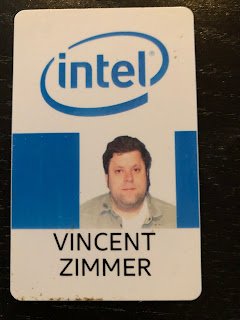
Fast forward to February 24, 1997 with the bushy-haired, suit-wearing engineer who showed up in DuPont, WA http://vzimmer.blogspot.com/2017/02/this-one-is-for-20-or-anniversarynext5.html.  
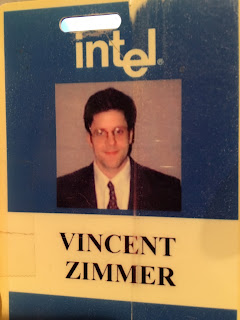

to


As I look at the things I've worked on, I am reminded of the quote regarding an ethos of 'missionary versus mercenary' when applied to your career. I know that it is something of a luxury to entertain that dialectic since extreme poverty would most likely preclude making that choice. In fact, I recall my father, who grew up as an orphan, reminding me 'money may not buy happiness, but lack of money can surely buy unhappiness.' As such, I believe there is a balance, and once the basic survival needs are requited, deciding which side of the fence you live on is key. Today's frothy job market and extreme compensation packages brings this dynamic up in stark contrast. But in general an interesting thought about career motivations. I fall on the side of missionary. 

I do have to say that this is one of the most exciting times to be in the technology industry. From my early career visiting FTP sites on dialup modems with a 286 to today having multi-core, multi-gigabyte machines and the world-wide-web with its online videos, books, papers, and source repos like Github. 

I became excited about Intel in the mid-90's reading about the company in magazines like EETimes and working on Intel technology, like bringing up a BIOS on a 430HX platform. When I was recruited to Intel to lead the 64-bit Merced/Itanium BIOS work, I was part of a 31% growth wave 1996 - 1997 https://www.chiphistory.org/chc_upload/content/pdf/19/1506018723/1506018723.pdf

Along the way many colleagues have left for other companies, retired or passed away. In addition, my role afforded me the opportunity to work with many parties outside of Intel, whether it be a direct customer, community and government agency. From each I have learned various lessons. These include the perils of arrogance, especially when people confuse correlation versus causation (i.e., something that happened versus their making it happen). 

I do recall one director who always seemed interested in the technology. I asked him why he took the management track. He recounted a tale of working as a compiler engineer at Burroughs early in his career and devoting himself to the project. One day an executive came in and cancelled the overall project. At this point the then-junior-software-engineer thought "I want to be the guy on that side of the table." He the then hung up his coding spurs and pursued an MBA. I admired this manage a lot and recall driving to Oregon for his retirement event. After decades at Intel and many projects he had set up a table with a placard in front of his various projects with a quote about his most memory impact. For UEFI I thought the card would say 'changed the ecosystem' but instead it said 'told the team to stop selling.' Less learned - check.

Another memory from that director included transitioning one of our internal product efforts from legacy BIOS to EDK. There was a heated debate in a forum, including a VP telling my boss 'our customers are not asking for this," with my boss replying loudly 'how can you lead on a strategy if you wait for the customer." This is a variant of https://www.businessinsider.com/steve-jobs-quote-misunderstood-katie-dill-2019-4 

Some people say give the customers what they want, but that's not my approach. Our job is to figure out what they're going to want before they do. I think Henry Ford once said, 'If I'd ask customers what they wanted, they would've told me a faster horse.' People don't know what they want until you show it to them. That's why I never rely on market research. Our task is to read things that are not yet on the page.

that I've seen quoted with various degrees of verity.

I've been on this project long enough now, namely joining the EFI team in 1999 and having it re-org'd around me multiply, that I encounter people explaining to me why something I created was done. That's a good thing in my opinion since it shows people are thinking deeply and passionate about the subject.

Speaking of done, I have enjoyed the opportunity to work various endeavors after I was recruited out of Compaq in 1996 and ended up joining the company in February 1997. The path included creating the first 64-bit Itanium BIOS and powering on first workstation. The delay in Merced, and not yet having children, afforded me the opportunity to drive to the University of Washington in Seattle and take courses for my Masters of Science in Computer Science. Toward the end both the birth of my daughter and power-on's made this a tough road to follow. The experience with Itanium afforded my first glimpse into moving 'beyond BIOS', whether it was 64-bit SAL and the PC/AT BIOS atop it for late POST, moving to the workstation effort with the clean-room Kittyhawk code base written in C.

After that I moved to the EFI effort in 1999, helping deliver content from the EFI 1.02, EFI 1.10, EFI 1.20 (never shipped but a subset donated to UEFI 2.0), UEFI 2.0 through UEFI 2.9. EFI was always the higher level pre-OS OS or boot load environment, but other that the plat driver directory, it was decoupled from the underlying platform initialization. To that end, the Kittyhawk effort may have donated some interesting concepts, but the "Tiano" program with with the "Intel Platform Innovation Framework for the Extensible Firmware Interface" (aka. 'the Framework') provided a set of building blocks, including PEI, HOB's, DXE, Data HOB, CSM, SMBUS, HII, SMM, etc.

The Framework specifications informed the creation of the Tiano codebase, which consumed the original EFI sample to become the EFI Developer Kit (EDK). EDK led the charge for the early to late 2000's and was then replaced by the EFI Developer Kit II (EDKII). The latter introduced more modularity via Packaging, PCD's, base libraries, etc.

The EDK and EDKII code bases were posted to sourceforge originally and the latter is now actively maintained on Github.  Most of the 10+ Framework specifications (sans data hub and CSM) were donated to the UEFI Forum, along with Framework-related patents, to become the UEFI Platform Initialization (PI) specification. The PI packaging specification was borne of the EDKII work and also donated, as was the UEFI Shell. Ironically the EFI Shell was conjured up in a few days to support the Itanium power-on, but it took on a life of its own thereafter.

Speaking of patents, Intel has afforded me the opportunity to work at various layers of the stack and get exposed to a plurality of problem statements. And it is the problem statements that are key to ideation in my opinion. One good problem can yield a wealth of patents. And the patents of course have to meet at least the criteria of novelty and value to my employer. The latter reminds me of the quote that 'if you are working on something that the business doesn't care it it's called a 'hobby.'' No time or budget for hobby-patents. 

So for projects, patents, papers, books, standards .... the most memory aspect has always been the collaborators. Technology comes and goes, but people and relationships are the most important. From working on the original Itanium BIOS and simulation and then hardware, to Tiano first booting on the 815 (writing the C-based PEI core and platform PEIM's), to porting EFI to Intel's XScale in 2001, to porting EDK to x64 via both the 2-headed BIOS and 64-bit DXE, to ...

And on standards, from the Framework specifications (PEI, SMM - and getting an IAA for Tiano in 2004), PI 1.0-1.7, .... Collaborating on NIST 800-147 (and getting an IAA for scaling signed updates in 2012), NIST 800-193 (and today's drive for platform resiliency), Open Compute Project https://cdrdv2.intel.com/v1/dl/getContent/671185, network booting (clean-room network stack, IPV6 certified stack, RFC 5970 https://www.rfc-editor.org/rfc/rfc5970.txt, HTTP & WiFi boot), UEFI secure boot & signed updates, EFI TCG measured boot https://cdrdv2.intel.com/v1/dl/getContent/671466......  I have tried to journal some of these things at https://sites.google.com/site/vincentzimmer/cv over time versus citing the same sources here.

I apologize in advance if the reader has gotten this far. This is the 14th year of posting to this blog site and I suspect this entry may win the prize for being the most incoherent. I guess the 24x7 Work From Home (WFH), or is it 'Living At Work' (LAW), lifestyle is bearing down on me, as is the backlog of time off I've yet to use. At Intel we accrue an 8-week sabbatical every 7 years, or a 4 week one every 4 years. I took my first sabbatical in 2004 with my wife and small daughters, including an Alaska cruise, etc. Fast forward to 2011 and I fell off a ladder 2 days into that sabbatical, leading to 2 surgeries and rehab during those 2 months (although I recall 1-hand typing out my articles for https://www.intel.com/content/dam/www/public/us/en/documents/research/2011-vol15-iss-1-intel-technology-journal.pdf during those final weeks of that sabbatical).. So not so much fun in '11. Fast forward to 2018 eligibility - I continued to delay during the 3 year window, which was then extended to 4 year window, which is now extended to August '22 for expiry. Given the latter extension I am now eligible for both my 8 week and a 4 week. Add that to 4 weeks of potential vacation in '22, and I'm sitting on a potential of 4 mos. time-away.  And in tech when is there an amicable time window to jump off this bullet train for a breather.....

Going forward, I see huge opportunities in the firmware space. These include some of the technology aspects of USF that allow for evolving the different layers of the stack at different rates. This includes safer languages and more rigor in testing/validation. https://twitter.com/veorq/status/1496177874264641536?s=20&t=SQKLjCN9DIykwSgU0pK6_Q reminds me of the ever present need. I am intrigued by the work described in https://www.amazon.science/blog/a-gentle-introduction-to-automated-reasoning. As an ironic twist of fate, the mention at the bottom of the page

A fun deep track:

Some algorithms found in the automated theorem provers we use today date as far back as 1959, when Hao Wang used automated reasoning to prove the theorems from Principia Mathematica.


seems invisible on the internet, at least the PDF. Luckily my pack-rat nature for books afforded me an ex-Lib edition of IBM Tech Journal from 1960
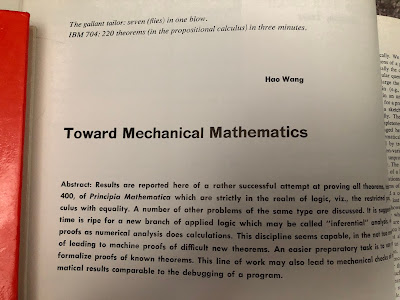


I regret that my fellow-travelers in the journey for more formal BIOS evaluation https://www.usenix.org/system/files/conference/woot15/woot15-paper-bazhaniuk.pdf are now retired, off to Eclypsium, or in the case of one of my heroes Mark Tuttle, off to the above listed Amazon Reasoning Group (ARG). I feel like we only scratched the surface in this space. Or maybe just a Quixotic question for a computing science Archimedes "Give me a lever long enough and a fulcrum on which to place it, and I shall move the world."


fin


Saturday, October 14, 2017

The march of time

As I read https://community.infoblox.com/t5/IPv6-CoE-Blog/Where-Are-You-On-The-IPv6-Adoption-Curve/ba-p/11116, I couldn't help but think of the progression of IPV6 support in UEFI.
We compared the adoption arc of the two efforts in
http://www.uefi.org/sites/default/files/resources/A_Tale_of_Two_Standards_0.pdf.

Interesting milestones on both the technology front https://tools.ietf.org/rfc/rfc5970.txt and in the specification uefi.org / codebase tianocore.org curation are shown below


In 2010 my colleague Bob Hale and I noted the following about Tiano www.tianocore.org

https://github.com/vincentjzimmer/Documents/blob/master/Neither-Seen-Nor-Heard.pdf.  9th generation in 2009.  Oh my.  Good thing we chose a different designation for the various types we snap EDKII trunk with the validated UDK releases https://github.com/tianocore/tianocore.github.io/wiki/UDK

Lots of changes these last few years. Another journey on this trip was meeting Paul Otellini in 2005. I was definitely saddened by the news https://www.theverge.com/2017/10/3/16411480/paul-otellini-death-intel-ceo


But change is part of the trip. I recently said good bye to my colleague Lee Leahy. He and I collaborated for several years and had the opportunity to co-present https://www.youtube.com/watch?v=I08NHJLu6Us


To remind us that he has retired to Hawaii, he left the following picture in the cubicle behind mine, taken from his new backyard.

A final marker of the change occurred when cleaning out some data books. The right hand side (RHS) is the programmers reference manual (PRM) for the 386SX, whereas the left hand side (LHS) stack includes the reference tomes for an Intel based CPU's from a couple of years ago (prior to all documents going online-only).

An example of the change include the RHS PRM description of an instruction such as SCAS. The description even listed the number of clocks to retire the instruction, which was possible in the days of simpler memory hierarchies, in order execution, etc.

The following shows the same instruction from the LHS.


More modes.  No clocks.  As times change, instructions change.

I look forward to chatting with people on Sunday about UEFI and security https://firmwaresecurity.com/2017/10/10/uefi-security-presentation-at-seattle-dc206-meeting/. It's interesting to see this talk having been referenced in a few places, such as https://www.cylance.com/en_us/blog/black-hat-vegas-where-the-guardians-of-the-bios-are-failing.html, https://medium.com/@matrosov/bypass-intel-boot-guard-cc05edfca3a9,  https://www.darkreading.com/vulnerabilities---threats/7-hardware-and-firmware-hacks-highlighted-at-black-hat-2017/d/d-id/1329442?piddl_msgorder=&image_number=6, and https://cloudplatform.googleblog.com/2017/08/Titan-in-depth-security-in-plaintext.html, too.

Speaking of change, time to break away from the PC.

PS
Update from 10/18/2017
Thanks to the Lodge

for great questions and attendance this weekend


Sunday, May 3, 2015

Open Compute Project, CanSecWest and new specifications from the UEFI Forum

"The goal in technical writing is not to be possible to understand, but to be hard to misunderstand."- Cook

"Writing is nature's way of letting you know how sloppy your thinking is." - Guidon

Background
This blog is probably disappointing Cook and affirming Guidon's wisdom at the same time.

The danger of delaying posting a blog is catching up with recent events. As such, I have a bit of content to soldier through in this posting. The most exciting of late is the posting of the UEFI 2.5, PI 1.4, and ACPI 6.0 specifications http://www.uefi.org/specifications, but the preceding events definitely argued for much of the content and motivation which has appeared in those specifications.

I was on the road for a few weeks in March and April. First I attended the Open Compute Project (OCP) Summer 2015 summit http://www.opencompute.org/community/events/summit/ocp-us-summit-2015/ in sunny San Jose.

After that I sojourned north to attend the CanSecWest (CSW) conference in less-than-sunny Vancouver, B.C., Canada.

Although OCP treated opening up the designs of servers, and CSW was an information security conference, there were some common threads, such as openness, firmware, UEFI,....

And speaking of openness, I finished the tour in southern Washington State at the Open Source Technology Summit (OSTS).

OCP
To begin, the Open Compute Project http://www.opencompute.org/ hosts a community where common elements to build out the data center, such as network switch, server board schematics, rack mechanicals, etc can be shared.


Many companies are involved in OCP, with a recent discussion of resultant hardware at http://www.anandtech.com/show/9138/open-compute-hardware-tried-and-tested.

The keynote videos and presentations can be found at http://www.opencompute.org/blog/ocp-u.s.-summit-2015-video-and-presentation-links/.

OCP has made a lot of progress on opening up board designs, chassis specs, etc over the last few years.  But aligning on firmware hasn’t been a first priority.  I chatted w/ one company VP and his engineer afterward.  The quote from engineer was “firmware is our biggest head-ache, it should have been the first focus area of OCP.” This is because of requirements around device update, boot policy, and other aspects of a system that read directly on host boot firmware.

Mallik Bulusu from Microsoft and I https://www.flickr.com/photos/106659057@N08/16966691206/in/set-72157651601950765 spoke about some of the problem statements and opportunities in the cloud.  Material presented can be found at:


This paper also treats briefly on the topic of open source support for these technologies and possibly entire server platforms.

Regrettably, the talk preceded the release of UEFI 2.5, ACPI6.0, and PI1.4, so we were not able to discuss some of that material as it was under UEFI Confidentiality at the time. We mentioned the firmware-related Cloud problem statements, such as scalable configuration and network provisioning. The latter, namely the boot-from-HTTP work defined in UEFI 2.5 via wire protocols, DHCP extensions, and new API's for HTTP, TLS, and DNS, will be touched upon later in this blog posting.

This talk seemed well-received, with some nice social media responses, too
2 retweets3 favorites
Reply
 Retweeted2
 Favorite3
More

Speaking of Curt Brune above, his company Cumulus announced a usage of ACPI http://www.enterprisenetworkingplanet.com/netsp/cumulus-networks-introduces-the-acpi-platform-description-apd.html for network switches. Essentially the effort entails making the switch look like a server for purposes of running general purpose OS’s.  That’s another trend that is auspicious for the UEFI Forum-based technology and Intel as a component supplier to the switch hardware as a more open platform.

Beyond accretion of new functional technology in the UEFI Forum specification corpus, there were discussions of open source from http://www.rackspace.com/ in the context of their Power8 support. Specifically, from
"The parts that Rackspace is changing are inside the server and will take advantage of all of the firmware and systems software work that Rackspace has done already with X86-based systems and will also leverage the open firmware that IBM and Google have created for Power8 systems, which weighs in at around 420,000 lines of code."

Facebook also had a session on open sourcing their BMC with Yocto Linux, and discussions around mini-BMC's and FreeRTOS were also in the air.

So the addition of consistency of interfaces, in addition to more openness in the development model were described.

Open source is a prevailing theme of this blog, and I was chided by some in the open source community that firmware should be one of these things:

1- either perfect at inception
or
2- give people the source to do themselves
or
3- remove from pre-OS altogether

I argue that no software is perfect, but a community can strive to patch software, #1 can become 'imperfect but will patch." This is a place where UEFI2.5, ESRT, and capsules can help.

On #2, there are challenges with technology like hardware-verified boot, where 'protecting the user' and 'allowing innovation' have some interesting tension.  NIST 800-147 reads on allowing for physically present users to bypass protections, and Chromebooks have both developer mode and the write-protect screw, so I believe that you can balance the end-user protection and choice dialectic.

Finally, on #3 maybe there is a path forward? For client systems that boot in non-human perceptible time, maybe deferring things like graphics initialization into the operating system and omitting from the pre-OS could be a future-looking option?

CSW
Next, I embarked on a road trip from Seattle to Vancouver, BC, to attend CanSecWest https://cansecwest.com/agenda.html


As shown in the agenda, the Friday sessions led off with three offence talks and one defender talk, namely mine.  Throughout the sessions Dragos reiterated "The BIOS vulnerability beatings will continue until morale improves." https://twitter.com/dragosr/status/578988308853698560

My talk, now posted at https://cansecwest.com/slides/2015/UEFI%20open%20platforms_Vincent.pptx was intended to provide an alternative perspective on the firmware ecosystem. I led off with a summary of the history of boot firmware, the present standards and open source activities, and detailed a list of the salient open source collateral and platforms.

The one slide that most resonated with the crowd detailed the difference between the open source trunk, with fixes on http://www.tianocore.org/security/ and the resultant product trees on shipping platforms.


This is again where UEFI 2.5 and capsule updates, ESRT, and OS support across the Linux upstreams, disributions, and Windows comes into play.

Luckily I had the opportunity to speak to David Aucsmith ahead of my session, and he mentioned that a review of UEFI Secure Boot as a "Ceremony" was an appropriate lens to apply https://eprint.iacr.org/2007/399.pdf.


Carl Ellison http://world.std.com/~cme/ was a great mentor http://www.google.com/patents/US7328340 of mine during his time at Intel. Methodologies like Ceremonies remind us that the security of a system is rarely just in the mechanics of the cryptography, but instead spans the human and organizational actors. In the case of UEFI Secure Boot this includes the ecosystem, manufacturing-time provisioning, end user and enterprise management, etc. All of these flows need to be considered for purposes of system assurance.

Speaking of mentors, happy to see http://www.google.com/patents/US9015455 issued with Jim Held http://newsroom.intel.com/community/intel_newsroom/bios?n=James%20P.%20Held&f=searchAll, too.

SUSE's pioneering work on MOK https://www.suse.com/communities/conversations/uefi-secure-boot-details/ is a great example of a broader view of the solution space and required technology. Additional details on SUSE's work was also discussed at http://intelstudios.edgesuite.net/idf/2013/sf/aep/STTS002/STTS002.html.

I also had the opportunity to meet with the USB Armory http://www.inversepath.com/usbarmory.html team. They described how ARM TrustZone (TZ), although an architectural CPU mode, has configuration issues. Specifically, each SOC vendor does the configuration differently of ranges reserved for TZ. I smiled since this is similar to some of the malaise around System Management Mode (SMM) on IA32/x64, namely a consistent set of CPU behaviors but different SOC/CPU/chipset configuration techniques per product families.

The final aspect of the talk included threat modeling and open platforms. On the former, I reminded the audience of the threat modeling that motivates today's UEFI features and some future looking opportunities on protection. I also reviewed the Quark and Minnowboard MAX platforms, with their fully and partially open source UEFI EDK II implementations, respectively, as great opportunities to collaborate. On the topic of the MAX I elaborated recently on some of these sentiments at http://firmware.intel.com/blog/security-technologies-and-minnowboard-max.

Although it was tough to follow several hours of attack talks on UEFI, I felt it important to show up at CSW for several reasons. I wanted to show that the UEFI community was engaged, concerned and results-oriented in the face of these issues afflicting the platform. And I also wanted to reach out to the researchers on how we can work together to make the platforms, and thus the internet, a safer place for all of us.

Beyond this talk, we also posted some material on how to defend a EDK II-based platform during boot http://firmware.intel.com/sites/default/files/resources/A_Tour_Beyond_BIOS_Using_Intel_VT-d_for_DMA_Protection.pdf.

The UEFI Forum has posted the revocation list, or DBX for UEFI Secure Boot, at http://uefi.org/revocationlistfile.

OSTS
My final stop has been the Open Source Technology Summit (OSTS), an Intel-hosted event in Skamania, WA. You can find some mention with the Twitter hash-tag #osts2015.

https://www.flickr.com/photos/davest/3339316813/in/photostream/ provides one view of the surroundings.

This final talk folded in some of the open source trends touched upon at OCP and CSW, and added some color on other community evolution.


I was jovial at the beginning, at least.


At this point I was fielding questions on secure boot, and I see that Linus in the audience has a grin.

Speaking of open source, another notable event since the last posting has been the release of the coreboot payload on http://www.tianocore.org. I mentioned this technology in http://firmware.intel.com/blog/edkii-fsp-and-other-topics and have some content in http://www.apress.com/9781484200711, but the code's now live at https://github.com/tianocore/edk2/tree/master/CorebootPayloadPkg and  https://github.com/tianocore/edk2/tree/master/CorebootModulePkg with a wiki at https://github.com/tianocore/tianocore.github.io/wiki/Coreboot_UEFI_payload.

Interesting community response after the posting included:

Patrick Georgi

Shared publicly  -  Mar 31, 2015

coreboot support in Tianocore (so Tiano acts as coreboot payload, providing UEFI services to the OS), committed by Intel employees.

I'm not sure I would have believed this 4 years ago.


Specifications
Although I cannot hope to do this topic justice tonight, I'd like to elaborate on
PI1.4 spec http://www.uefi.org/sites/default/files/resources/PI_release_1_4.zip,
ACPI6.0 http://www.uefi.org/sites/default/files/resources/ACPI_6.0.pdf, and
UEFI2.5 http://www.uefi.org/sites/default/files/resources/UEFI%202_5.pdf,
as described in the press release http://www.uefi.org/node/897.

On the back of the PI1.4 release, the Intel Firmware Support Package (FSP) 1.1 release has also been made
http://www.intel.com/content/dam/www/public/us/en/documents/technical-specifications/fsp-architecture-spec-v1-1.pdf. The latter leverages some of PI1.4, such as the graphics HOB definition. We also published a couple of papers on the creation / production of a FSP http://firmware.intel.com/sites/default/files/resources/A_Tour_Beyond_BIOS_Creating_the_Intel_Firmware_Support_Package_Version_1_1_with_the_EFI_Developer_Kit_II.pdf and consumption / integration / usage http://firmware.intel.com/sites/default/files/resources/A_Tour_Beyond_BIOS_Using_the_Intel_Firmware_Support_Package_Version_1_1_with_the_EFI_Developer_Kit_II.pdf, respectively.

These specifications tie into the above talks via a few threads. One thread is the need to evolve UEFI technology for the cloud, and to that end the boot-from-HTTP portion of the UEFI 2.5 specification squarely targets this space. Below shows schematically model of booting wherein TFTP (and thus UDP) based PXE can move to HTTP (and thus TCP) based booting. The move to a connection oriented protocol removes some of the chronic data center complaints, such as time-outs in "booting the Skynet" http://en.wikipedia.org/wiki/Skynet_%28Terminator%29, or more formally, provisioning warehouse-scale computers http://research.google.com/pubs/pub35290.html.


In addition to the wire protocols and DHCP extensions, additional API's for the network boot program were created, such as HTTP, DNS, and TLS. The latter allows for an optional boot-from-HTTP-s flow. This solution also allows for in-band and out-of-band RESTful messaging, such as http://www.redfishspecification.org/. Although many data centers use dark fibre and don't have threat models beyond the integrity concerns mitigated by UEFI Secure Boot, TLS allows for confidentiality cover where deemed necessary.


And TLS comes more into play in order to support another scenario enabled by the UEFI 2.5 specification, namely boot-from-wifi.  Wi-Fi security requires a supplicant, which is typically EAP-TLS support. So the UEFI 2.5 specification updated EAP to work on concert with TLS for the WI-FI use case. Some of the WI-FI support is shown below.

In addition to WIFI, Bluetooth support was also added to the UEFI 2.5 specification. This allows for building IOT-style usages in UEFI, but more importantly works in tandem with WIFI above for the no-wires style usages found in today's phone, tablets, and slim laptops. Without this wireless evolution, UEFI and its wired networking support was becoming more of a server/datacenter technology and missing some of the prevailing client trends.


In order to support boot-from-HTTP, and other firmware network boot art, such as U-Boot, the
http://www.iana.org/assignments/dhcpv6-parameters/dhcpv6-parameters.xml list has also evolved since the last blog posting.

Processor Architecture Types

Registration Procedure(s)
Expert Review
Expert(s)
Vincent Zimmer
Reference
[RFC5970]
Available Formats

CSV
Type Architecture Name Reference 
0x00 0x00x86 BIOS[RFC5970][RFC4578]
0x00 0x01NEC/PC98 (DEPRECATED)[RFC5970][RFC4578]
0x00 0x02Itanium[RFC5970][RFC4578]
0x00 0x03DEC Alpha (DEPRECATED)[RFC5970][RFC4578]
0x00 0x04Arc x86 (DEPRECATED)[RFC5970][RFC4578]
0x00 0x05Intel Lean Client (DEPRECATED)[RFC5970][RFC4578]
0x00 0x06x86 UEFI[RFC5970][RFC4578]
0x00 0x07x64 UEFI[RFC5970][RFC4578]
0x00 0x08EFI Xscale (DEPRECATED)[RFC5970][RFC4578]
0x00 0x09EBC[RFC5970][RFC4578]
0x00 0x0aARM 32-bit UEFI[RFC5970]
0x00 0x0bARM 64-bit UEFI[RFC5970]
0x00 0x0cPowerPC Open Firmware[Thomas_Huth]
0x00 0x0dPowerPC ePAPR[Thomas_Huth]
0x00 0x0ePOWER OPAL v3[Jeremy_Kerr]
0x00 0x0fx86 uefi boot from http[Samer_El-Haj-Mahmoud]
0x00 0x10x64 uefi boot from http[Samer_El-Haj-Mahmoud]
0x00 0x11ebc boot from http[Samer_El-Haj-Mahmoud]
0x00 0x12arm uefi 32 boot from http[Samer_El-Haj-Mahmoud]
0x00 0x13arm uefi 64 boot from http[Samer_El-Haj-Mahmoud]
0x00 0x14pc/at bios boot from http[Samer_El-Haj-Mahmoud]
0x00 0x15arm 32 uboot[Joseph_Shifflett]
0x00 0x16arm 64 uboot[Joseph_Shifflett]
0x00 0x17arm uboot 32 boot from http[Joseph_Shifflett]
0x00 0x18arm uboot 64 boot from http[Joseph_Shifflett]
0x00 0x19-0xff 0xffUnassigned

In addition to boot-from-HTTP, DNS, TLS, wireless, Bluetooth, UEFI 2.5 also added REST support. REST can be built upon the new HTTP API for in-band networking usages, such as https://www.redfishspecification.org/, or via out-of-band to a baseboard management controller (BMC), with the new BMC device path providing identity.

As the chair of the UEFI Networking Sub-Team (UNST) and the UEFI Security Sub-Team (USST), I am proud of the work that the team members did the create this collateral.

And this is just a taste. USST also produced interfaces for inline cryptographic interface (ICI) hardware, smart cards, enterprise deployment of UEFI Secure boot, additional protection capabilities of the boot, stylized operating system and platform recovery, among the various additions. I am working with the subteams to provide rationale documents in order to let the world into the insights and deliberations that gave birth to these new technologies. In no way can a blog like this hope to scratch the surface on the topic areas.

Upcoming talks

Next stop of the talking tour is a bit easier for me. I only need to wander to the nearby UEFI Plugfest in Seattle to speak about "Addressing Firmware Challenges for the Cloud with UEFI" in mid-May http://www.uefi.org/node/887. This is a variant of the OCP talk above that will include insights and matter that is now public in the UEFI 2.5, ACPI 6.0, and PI1.4 specifications.

And then it's off to San Francisco to share a panel talk at the Design Automation Conference (DAC)
http://www2.dac.com/events/eventdetails.aspx?id=182-18 on hardware versus software security.

TUESDAY June 09, 1:30pm - 3:00pm | Room 300 
TRACK: SECURITY
TOPIC AREA: SECURITY

SESSION 18
PANEL: Design for Hardware Security: Can You Make Cents of It?
Moderator:

Saverio Fazzari - Defense Advanced Research Projects Agency, Washington, DC

Organizer:
 Saverio Fazzari

Given the proliferation of counterfeit electronics in the supply chain, recent breaches at major retailers and the ever-growing Internet of Things, there is evidence that electronic hardware is the "new frontier" for security compromise.  Yet the protection of hardware continues to take a back seat to software in cyber-defense. How real is the problem of hardware security?  Should there be a stronger push to develop and deploy security techniques in design? Finally, is there money to be made in hardware security? Who benefits and who pays?  


Panelists:

Ingrid Verbauwhede - Katholieke Univ. Leuven, Belgium
Siva G. Narendra - Tyfone, Inc., OR
Vincent Zimmer - Intel Corp., Seattle, WA
Dino A. DaiZovi - New York Univ., New York, NY
Lisa McIlrath - Raytheon BBN Technologies, Cambridge, MA

I'm glad to see "Intel Corp, Seattle, WA" next to my name. I'm hoping to put more of the Intel-in-the-Emerald-City visibility out in the community.

On the latter topic of "Hardware Security", as the 'firmware guy' it's always interesting to see which side of the fence I most straddle (psst - I still say 'software').


Tuesday, February 24, 2015

Anniversary .next ^3 and 3 behaviors

Today marks eighteen years in my Intel journey, so I am keeping up the tradition of writing a blog entry on this day, as started with http://vzimmer.blogspot.com/2012/02/anniversary-day.html. The title exponentiates '.next' versus '.next.next.next'-style usage. This makes me eligible for a half-sabbatical, too. Since the last posting I've firmly moved into the new Seattle office. Below is a picture of the facility from across the street. It is located in south Seattle, adjacent to the International District.


I managed to get a cube-with-view, too.


The view also affords me a vantage in case of an invasion https://twitter.com/vincentzimmer/status/565562482383527936


So with a new office and work anniversary afoot, I will continue my blogging tradition. I'll begin with a few thoughts on being an engaged engineer. These sentiments include:

1. Being present

Even before chancing across http://www.forbes.com/sites/ellevate/2015/02/20/why-face-to-face-meetings-are-so-important/ this evening, I have always believed in face-to-face engagements in the workplace. Although I've always worked at a remote site, namely WA-state Intel, I purposely go out of my way to visit the larger sites, such as Intel in Hillsboro, OR, or the headquarters in Santa Clara.

It's imperative to have such meetings early in an engagement so as to build rapport, and then possibly maintain the relationship remotely for subsequent collaboration. Showing up demonstrates that 'you care' and that the other person 'matters.' Nothing can substitute for these gestures.

Also, having badged into five Intel sites across three states during the preceding four-day-week  using plane, train, and automobile, I have recently practiced what I'm preaching on this topic.

2. Saying you don't know

A colleague in Oregon last Thursday suggested I treat this topic, although I've opined on it before. So here goes.

Another behavior I've observed includes reluctance of many technical leader to say "I don't know." Not having the immediate answer is OK. Just commit to following up and supporting the party. Feigning understanding doesn't help your standing with the other party or the overall business goals.

The technology and business landscape changes constantly. Strictly speaking it's impossible 'to know' everything.' But it is possible to keep and open mind, customer-oriented disposition, and desire to 'learn.'  Let an occasional 'I don't know' help fuel the fire of curiosity and pedagogy.

I've touched on the former two items in past blogs, but I have yet to treat the next topic.

3, Ownership

In general, ownership can be powerful in that it highlights the party culpable for furthering a business or technical agenda. Recently, though, I've seen the dark side of ownership. For example, in some discussions people will assert "I own that." This is a variant of the logical fallacy of argument from authority in that the act of ownership is posited in lieu of providing other data, such as results.

Instead of 'ownership', I am more of a fan of 'helping lead,' 'coordinate', 'drive'. What matters is the business result. None of us truly 'own' anything in the company. The upper management, and reductio ad absurdum, the stockholders, 'own' the company. We are entrusted as employees, and especially as technical leaders, to drive a goal.

On the flight Friday morning, a senior manager gave me a nice definition of a leader. Minimally, a leader must 'have followers' and 'make changes.' I'd say that's necessary but not sufficient. Sufficiency may include a qualification of change such that it is 'conducive to the growth of the business,' and followers who 'grow and advance in their careers' as a result of the interaction. Good stuff.

So next time I hear "I own X," I'd rather hear "This is what we've produced with X."

So speaking of X's, let's talk about security and open source.

On the security front, I don't want to say too much other than note that I'll be speaking at CanSecWest (CSW) next month https://cansecwest.com/post/2015-02-01-11:00:00_Speaker_Announcements. The title of my talk, "UEFI, Open Platforms, and the Defender's Dilemma", sums up my thoughts on platform security.

To begin, let's dissect the title. The first portion of the title UEFI provides mechanism, such as many of the technologies found on http://www.tianocore.org and also recent write-up's like http://firmware.intel.com/sites/default/files/resources/A_Tour_Beyond_BIOS_Using_Intel_VT-d_for_DMA_Protection.pdf.

The next portion of the title Open platforms provides a great opportunity to demonstrate a reduction to practice of these technologies, with a goal of demonstrating the design intent of the specifications in bits.

Finally, the defender's dilemma element of the title will review the relative asymmetry of platform defenders to the attackers. The cardinality of the attack presentations at this conference, namely 3 offense UEFI talks, to my 1 defense talk, brings this home. In fact, I represent one of the few defense talks hosted to be found in this conference series.

So let's get to the mapping of our three behaviors to the elements of the title. I will present in person so I get a check-mark on #1 of Being Present without much fan fare. On the topic of saying I don't know, I will not take the posture of being the omniscient guru of firmware. Instead, I want to enjoin the researchers in a dialogue, learning from them as much as I might be teaching. And I may up uttering those 3 humbling words more than I'd like. Finally, I would never claim to "own" platform security. There is a rich community of security professionals with whom I have the honor of working in the UEFI forum, open source community, and as professional colleagues. We all collaborate on providing a solution. I might lead in some venues, such as the UEFI Forum, but I am loathe to ever say I 'own' this topic area.

So that's for CSW next month.

Another application of these 3 behaviors to an X an include open source and open platforms. I've talked in the past about how thing like Intel(R) FSP can support various open source ecosystems and my excitement around Intel(R) Quark-based platforms like Galileo having open sourced their EDK II implementation. I also noted in my Intel Developer Forum 2014 talk that a book was coming. Well, the book Embedded Firmware Solutions: Development Best Practices for the Internet of Things has been published and can acquired via http://www.amazon.com/Embedded-Firmware-Solutions-Development-Practices/dp/1484200713/ or http://www.apress.com/9781484200711.


An interview with the authors was also recently posted, too http://www.se-eng.com/2015/02/authors-of-embedded-firmware-solutions-include-key-industry-architects-of-open-solutions/.

I am a believer in collaboration, too. This book adds Google and Sage to the list of companies with whom I've publicly presented and co-authored material. Examples can be found at https://www.linkedin.com/in/vzimmer and includes AMI, Cisco, Dell, HP, IBM, Insyde, Intel, McAfee, Microsoft, NICTA, Phoenix, SuSE, Toronto.

So how do the three behaviors map to this topic? The easiest to answer is 'being present.' In the earliest days of Intel FSP and this book I had the opportunity to meet my colleagues in Mt. View, San Jose, and San Francisco. In this various venues I helped forge a relationship that evolved remotely, but the pioneering engagement was face-to-face.

And on the topic of "I don't know", I have to cite the spate of libre boot emails I received internally and externally in the wake of announcements like http://www.fsf.org/news/libreboot-x200-laptop-now-fsf-certified-to-respect-your-freedom. I don't know the extent to which the various business partners can open, but I'm always open to learn about the various viewpoints and desires of the ecosystem. But I do believe in more openness and transparency, just as 'open' is in my CSW title and talk, and the book above talks about 'open' solutions.

And finally, I don't 'own' open source firmware and platforms at Intel. I am luckily to have spent the last 15+ years on a team that has been open sourcing reference implementations of industry standards and firmware. We recently posted some elements of http://firmware.intel.com/projects/minnowboard-max to http://www.tianocore.org, such as https://github.com/tianocore/edk2/tree/master/Vlv2DeviceRefCodePkg and https://github.com/tianocore/edk2/tree/master/Vlv2TbltDevicePkg. These packages, and the ability to absorb Intel FSP binaries from http://www.intel.com/fsp, along with the more granular source plus binary builds, shows progress toward more open platforms in this community.

So that's about it for the inaugural blog of 2015. I've marked a work anniversary with a blog three-years-running on this date, I discussed three behaviors, and finally, I mapped those three behaviors to two case studies.

I have been invited to co-present at the Open Compute Summit http://www.opencompute.org/community/events/summit/ocp-us-summit-2015/ next month, too. I should have conjured up a 3rd case study on this topic area of "firmware and Cloud" challenges" to have a 3-3-3 balance in the former paragraph, but work beckons and time to close up this entry.

Have a safe and happy rest of 2015 to all.