Given it is the final day of 2014, I thought that my final blog of 2014 would treat the year.next which commences in a few hours, maybe with another one of my infamous TL:DR-style postings? Specifically, I'd like to build upon missive from Tim Lewis at
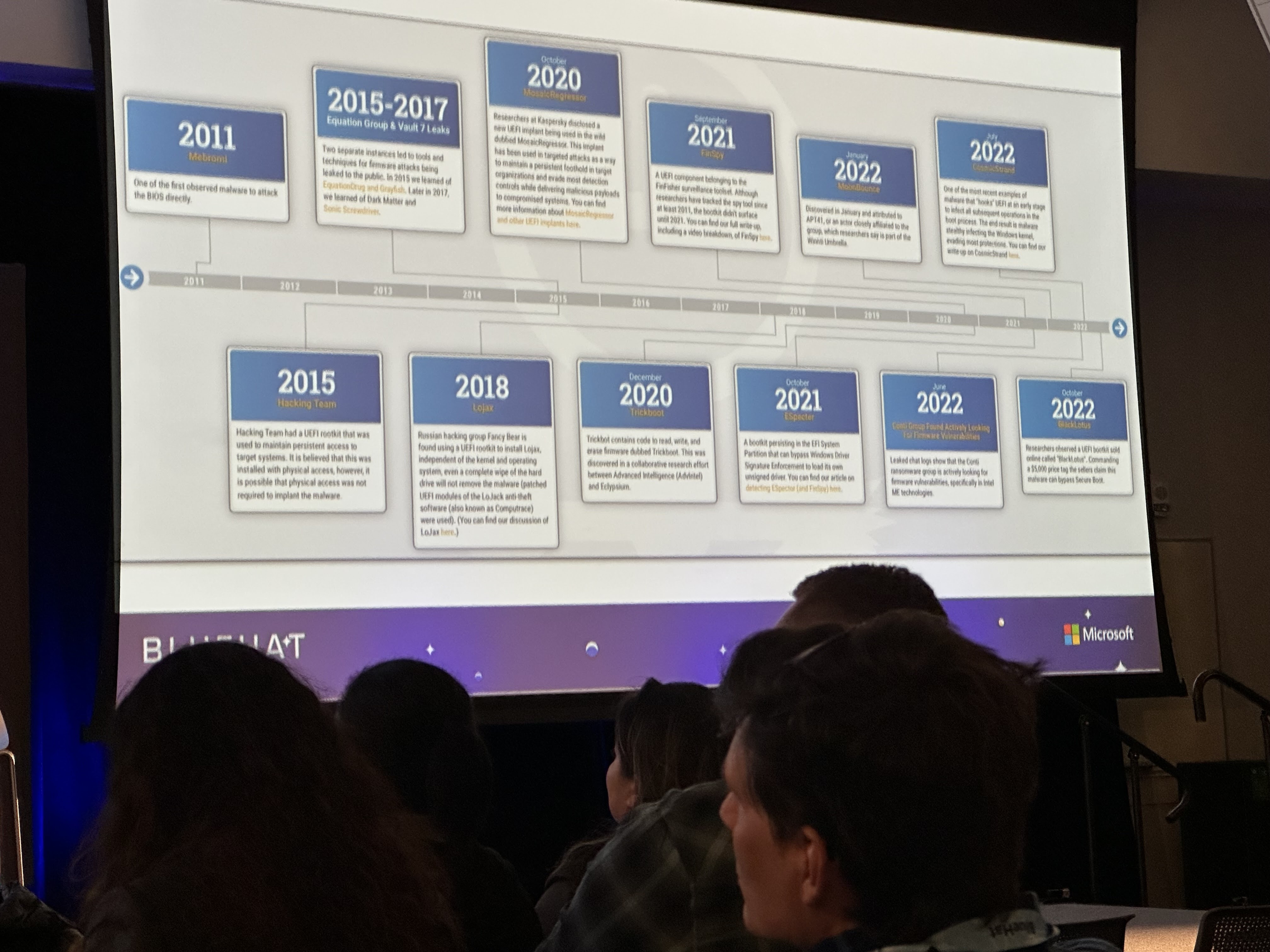
http://uefi.blogspot.com/2014/10/security-to-eclipse-user-features-as.html wherein he shared his belief that security concerns in the platform firmware will predominate as the top user story of 2015. Given the sampling below from 2014, he may be observing an unenviable trend line.
Regarding that trend, there have been talks at several venues in 2014, such as the Black Hat (BH) talks a few months ago
https://www.blackhat.com/docs/us-14/materials/us-14-Kallenberg-Extreme-Privilege-Escalation-On-Windows8-UEFI-Systems.pdf. This talk had an associated CVE
http://www.kb.cert.org/vuls/id/552286 and white paper
https://www.mitre.org/sites/default/files/publications/14-2221-extreme-escalation.pdf.
In addition, just this week there were a couple of talks featured on UEFI at the Chaos Communications Conference (CCC), including
https://www.youtube.com/watch?v=5BrdX7VdOr0 and the associated presentation
https://frab.cccv.de/system/attachments/2557/original/AttacksOnUEFI_Slides.pdf
by researchers from Bromium and Mitre, respectively.
The other CCC talk was on EFI and Thunderbolt
https://www.youtube.com/watch?v=5BrdX7VdOr0. Glad to hear from the Matthew Garrett question to the presenter near the end of the talk that the option ROM vulnerability could have been mitigated if the Apple platforms implemented UEFI Secure Boot with option ROM verification (i.e., UEFI Driver Loading) enabled.
These security events and broad use of UEFI and edk II-based platforms definitely argue for the need to have additional industry coordination. This is a role that CERT has done admirably, but as Tim noted, they are now joined by the UEFI Security Response Team (USRT)
http://www.uefi.org/security. This effort has been followed by a more code base-specific effort, too
http://tianocore.sourceforge.net/wiki/Security. I am happy to be involved in both and although my CVSS-Fu isn't too evolved yet, I'm trying my best in writing technical advisories and doing the associated grading.
It is interesting that the references for both BH and CCC
https://www.youtube.com/watch?v=5BrdX7VdOr0 talks above cite the Intel Framework Specifications at
www.intel.com and not the superseding UEFI Platform Initialization (PI) specifications
http://www.uefi.org/sites/default/files/resources/PI_Spec_1.3.zip. This might contribute to some of the ambiguity seen in the boot script implementations, for example, noted in the CCC talk, since the Intel Framework specifications are frozen after having been contributed to the UEFI Forum. Maybe posting a ZIP of the PI specs and a PDF of the Framework makes the latter more search-engine friendly?
For the CCC talk
https://frab.cccv.de/system/attachments/2557/original/AttacksOnUEFI_Slides.pdf, it was good to see that slide 53 mentions the work done with my Intel colleague
[11] A Tour Beyond BIOS:
Implementing S3 Resume with EDK2 –JiewenYao and Vincent Zimmer,
October 2014
Jiewen and I designed features like the Lock Box protocol
https://github.com/tianocore/edk2-MdeModulePkg/blob/master/Include/Protocol/LockBox.h to allow for protecting the boot script memory, via SMM or other container, back in 2009. But issues in seeing the protections deployed are compounded by the sheer difficulty in implementing S3 resume in platforms. Specifically, getting the functionality correct and having less-easily testable properties like securing the boot script has proven challenging. As a platform developer the last call you want to hear during product development is from the SQA team, saying "Everything works great, but our S3 resume testing fails once out of 10,000 times."
The above S3 document represents part of an effort to document some of the design intent on edk II source artifacts. We already have architectural intent documents such as
http://www.cs.berkeley.edu/~kubitron/courses/cs194-24-S14/hand-outs/SF09_EFIS001_UEFI_PI_TCG_White_Paper.pdf (including the companion talk
https://www.youtube.com/watch?v=lZ505uz1TZ4).
Regarding other defenses, in the S3 talk Corey also mentioned the "SMI Transfer Monitor" (STM). Corey's co-presenter Rafal discusses the STM in more detail at
http://invisiblethingslab.com/resources/bh09dc/Attacking%20Intel%20TXT%20-%20paper.pdf. This is also mentioned in CCC 2013 talk
http://events.ccc.de/congress/2013/Fahrplan/system/attachments/2266/original/Gal_Diskin_-_Virtually_Impossible_-_30C3__release_version_.pdf by former Intel researcher Gal Diskin.on slide 13. Chapter 13 of Grawrock's 2nd edition of Safe Computing
http://www.amazon.com/Dynamics-Trusted-Platform-Building-Approach/dp/1934053171 also describes this feature. The gist of the STM is that it represents a usage of the peer-monitor capability in IA32, a hardware feature defined in chapter 34.15 of the Intel Software Development Manual (SDM)
https://www-ssl.intel.com/content/www/us/en/processors/architectures-software-developer-manuals.html. There is a nice peer monitor overview at
http://virtualizationtechnologyvt.blogspot.com/2011/07/vmx-and-smm-dual-monitor-mode.html. The use of the peer monitor, which is essentially virtualization controls in System Management Mode (SMM), allows for de-privileging today's ring 0 SMM code, such as that built responsive to the infrastructure in volume 4 of the PI 1.3 specification
http://www.uefi.org/sites/default/files/resources/PI_Spec_1.3.zip. So when Corey said "where is the STM specification?", he was referring to the firmware convention for loading the STM, interaction with Intel TXT, and how to expose resource lists for which the guest SMM code can access. This class of firmware interaction is the "STM specification" and it is built upon the hardware specifications of the peer monitor virtualization capability treated in the SDM. The SDM is the bible for software-visible parts of IA32, i.e., the 'architecture.' The SDM hasn't changed over the last decade plus, whereas the STM specification has, er, evolved.
typedef struct {
UINT32 VendorId;
EFI_GUID ReferenceManifestGuid;
} TCG_Sp800-155-PlatformId_EventStruct
Well, if you have gotten this far, the 'Didn't Read" portion of "Too Long, Didn't Read" (TL;DR) hasn't been the case for you. I'm not sure whether to reward you for your stoicism or not for wading through this entry.
To summarize, 2014 has shows a spate of security-related activities, both by the attackers (BH, CCC) and the defenders (USRT). The firmware-producing and consuming community is acutely aware of assurance concerns and new testing methodologies have been deployed in '14 and are coming in '15, too, including HSTI. I don't necessarily subscribe to the 'Spy versus Spy' aspect of security, or fall into existential angst that the "Defenders Dilemma" is not solvable. Instead, I see many parties passionate about having robust, usable systems and collaboration on art to achieve those goals. Open source, open documentation, open specifications, open platforms,.... All help in the cause.
And if you're still working these last hours of today, pause and have a coffee.

Also, enjoy a
happy and safe new year.
Cheers,
V.Z.兹梅